
How to Compress the Golf Ball Properly: Stop Scooping/sweeping Your Irons!

If you feel like your iron shots never come off the face with that clean, heavy, penetrating strike you see from better players, there is a very good chance the issue is not your clubhead speed, your strength, or your equipment. More often than not, the real problem is that you are not compressing the golf ball properly.
At My Golf Matters, one of the most common swing issues we see is golfers trying to help the ball into the air by scooping or sweeping it off the surface. It is understandable. The ball is sat on the ground, so instinctively many players feel they need to lift it. But with irons, that instinct usually works against you.
Instead of producing a crisp strike with ball-first contact, scooping tends to move the bottom of the swing arc too far back, add unnecessary loft, reduce compression, weaken strike quality and make distance control far less reliable. It can also have a big effect on face control through impact, which is why so many golfers who sweep the ball see a common miss left, especially with short and mid irons.
What does it actually mean to compress the golf ball?
Compression in normal coaching language refers to striking the ball with a descending blow, controlling the loft presented at impact, and contacting the ball before the turf so that the energy transfer is more efficient and the strike feels solid. It is not about trying to smash down violently on the ball or rip huge divots out of the ground. It is about having the club travelling in the correct part of the arc when it reaches the ball.
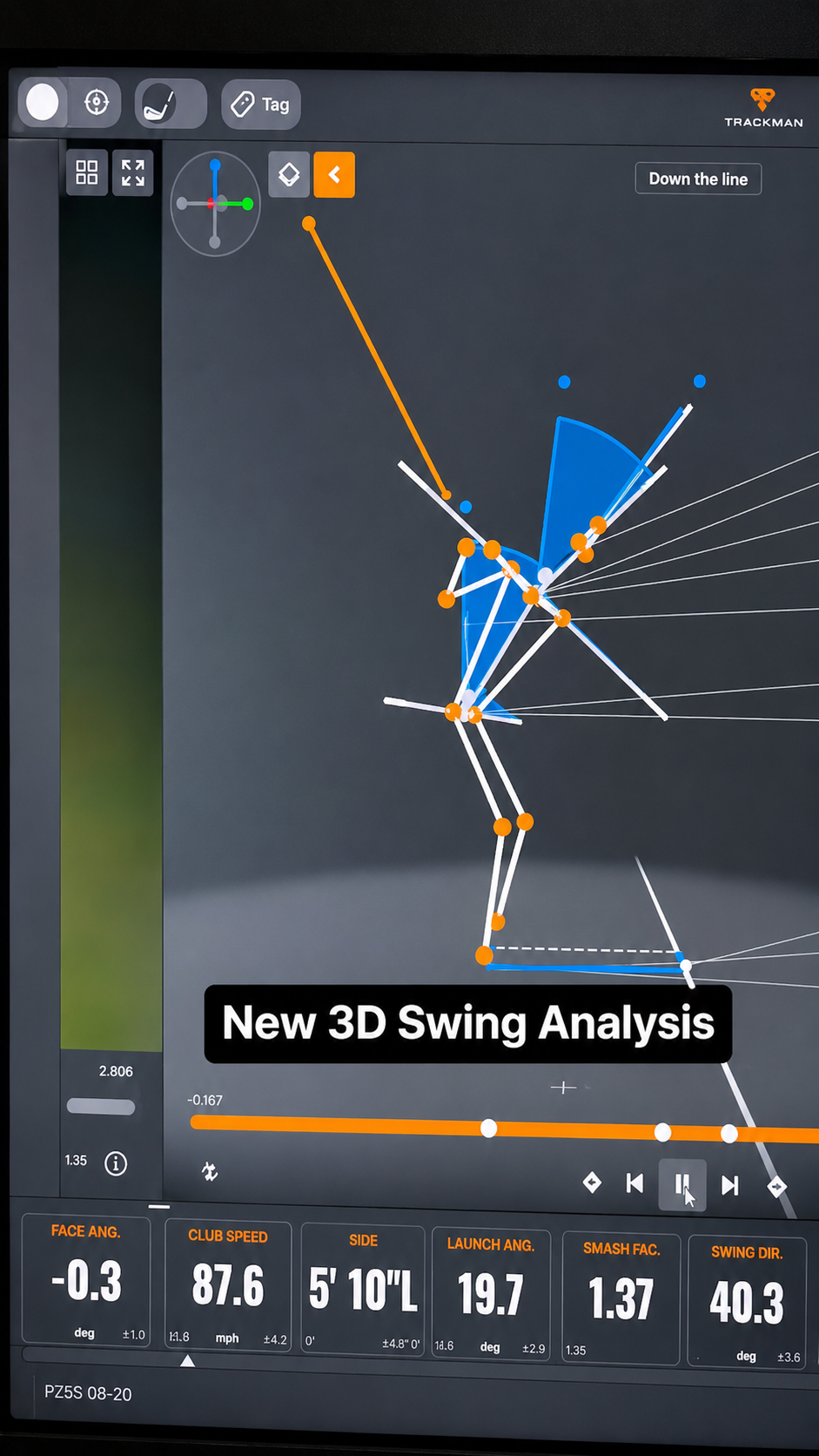
TrackMan defines attack angle as the vertical direction the clubhead is moving at maximum compression. For shots played from the ground, TrackMan states that attack angle should typically be negative, meaning the clubhead is travelling down rather than up at impact. TrackMan also explains that low point for a downward strike should occur after the golf ball, which is one of the clearest ways to understand proper iron contact.
That matters because if your low point is behind the ball, the club tends to bottom out too early. From there you usually get one of two poor outcomes. You either catch the turf first and hit the shot heavy, or you avoid the ground and flick the club through impact, producing a thin, weak, high-launching strike that never feels fully compressed.
Why scooping and sweeping cause so many iron problems
Golfers who scoop the ball often think they are being shallow or smooth, but in reality they are usually adding loft, losing pressure into the lead side too late, and striking the ball too late in the arc... That creates a long list of common problems.
The first is a lack of distance. When the strike is weak and the club arrives with too much dynamic loft, you often lose ball speed and create a flight that looks high enough but does not go anywhere near far enough for the club.
The second is inconsistent strike quality. Because the club is bottoming out in the wrong place, your contact point moves around too much. One shot is thin, the next is heavy, the next comes out dead off the face.
The third is face control. Many golfers who sweep the ball present the club differently through impact because they are trying to rescue the strike at the last second. That can lead to a face that shuts too early and produces that familiar pull or pull-draw left.
The fourth is poor turf interaction. A good iron player does not need to take a massive trench, but there is usually some evidence that the club has continued descending through the ball and interacted with the ground after contact. If there is never any sign of that with your irons, it is worth checking whether your low point is too far back.
What the data says
The useful thing here is that this is not just opinion. Launch monitor data gives us objective benchmarks.
TrackMan’s published PGA Tour averages show a 6-iron attack angle of -3.7° and a 6-iron smash factor of 1.39. In simple terms, elite players are generally striking irons with a descending blow and converting club speed into ball speed very efficiently.
TrackMan also notes that for a 6-iron, its optimiser’s standard assumption is around -3.2° attack angle, reinforcing that a downward strike is normal and desirable for iron shots from the ground.
Golf Digest reported testing by Michael Parente using a robot swing model, where hitting down on a 7-iron at 7 degrees, described there as typical of a tour pro, produced 10 to 23 more carry yards and 16 to 26 more total yards compared with much shallower or upward amateur-style impact conditions. The same article notes that amateur patterns of -1° and +2° were used as comparison points.
That does not mean every golfer should chase an exact tour number. It does mean that if you are trying to pick the ball clean with almost no downward strike, there is a strong chance you are leaving distance, control and consistency on the table.
A quick note on divots...
A lot of golfers misunderstand divots. The goal is not to take the biggest divot possible. The goal is to have the club strike the ball first and then contact the turf after impact.
Some excellent ball strikers take very shallow divots. Some take more pronounced ones. The key is not the size of the divot, but where it starts. If your divot starts behind the ball, that is poor low-point control. If it starts just after the ball, that is much closer to what we want.
So if you never take a divot, it does not automatically mean your swing is bad. But if you also lack distance, struggle with strike quality, hit weak shots left, or feel like your irons have no real compression, then the absence of turf interaction can be an important clue.
Why “just move the ball back” is usually the wrong fix
One of the biggest mistakes golfers make is trying to force compression by moving the ball back in the stance. Sometimes that can create a temporary change in contact, but it often just masks the real issue.
If your body motion is poor, your pressure shift is late, and your low point is behind the ball, moving the ball back may only change where the collision happens. It does not necessarily improve the motion that created the problem in the first place.
At My Golf Matters, we do not solve this by throwing setup bandages over movement problems. We solve it by showing you what your body is doing, how the club is moving, where low point is, and how to change the movement pattern so you can strike the ball properly without relying on awkward compensations.
How we fix poor compression at My Golf Matters
The reason so many golfers stay stuck with sweeping and scooping is because they cannot feel what is actually happening. They often think they are shifting forward. They think they are hitting down. They think the strike is improving. But the data and video usually tell a different story.
That is why our process is built around clarity. First, we show you the movement. Using video and high-speed camera feedback, we can show exactly how your body is behaving through transition and impact.
Second, we measure the key numbers. TrackMan lets us see attack angle, low point and strike pattern so we can separate assumption from fact.
Third, we build a simple movement change. In most cases, the golfer does not need ten technical thoughts. They need one or two clear feels that help them shift better, organise their body more effectively through impact, and move the bottom of the arc forward.
As those movement patterns improve, the strike changes. You start to see more downward attack with irons, low point moves more forward, strike quality improves, and the ball flight becomes stronger and more predictable. In many cases, golfers also notice that their body movement looks more athletic and dynamic on camera almost immediately.
Most importantly, this is not just about nicer numbers on a screen. It is about producing shots that actually transfer onto the course. Better compression normally leads to better distance, more reliable carry numbers, tighter face control and improved consistency throughout the bag.
Can this really improve quickly?
Yes, in many cases it can. Not every golfer fixes years of poor strike in one hour, but it is very common for players to make a big improvement in a single session once they understand what compression really is and why their current pattern is not working. Because the issue is often misunderstood, simply seeing the real cause on video and in the data can be a huge breakthrough.
That is especially true for golfers who have spent years being told to keep their head still, keep the ball position the same, or try to lift the ball cleanly off the grass. Once they realise the goal is to move the low point forward through better motion, not to help the ball up, the strike can change very quickly.
If your irons feel weak, inconsistent or left-biased, this may be exactly what is missing
If you struggle with any of the following, poor compression could be a major part of the problem: You rarely take a proper divot with your irons.Your contact feels weak even when it looks acceptable.Your common miss is a pull or a shot that starts left.You hit a lot of thin shots, heavy shots or floaty irons that come up short.You feel like you have to help the ball into the air.You have never actually measured your attack angle or low point before.
These are all things we see regularly in golf lessons at My Golf Matters, and they are exactly the kind of issues that respond well to a structured, data-led coaching session.


The article is well structured and the ideas are expressed clearly. The text manages to cover the subject without being superficial. I read several articles on this topic and this seemed among the most complete. This kind of content is hard to find in such a well-structured form.